
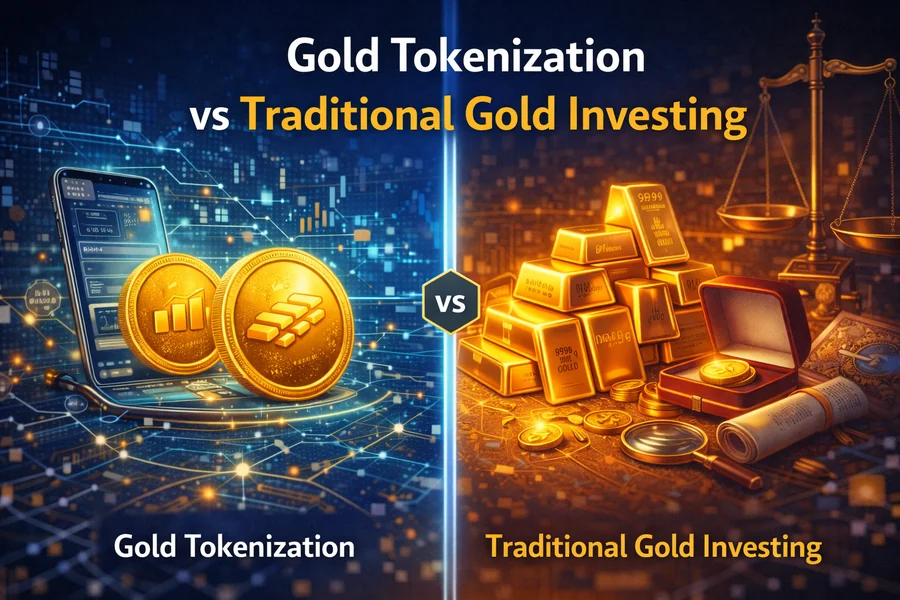
Gold has long been regarded as a safe-haven asset, trusted for preserving value across economic cycles. Traditionally, investors have accessed gold through physical bars and coins, gold ETFs, or gold-backed certificates. However, with the rise of blockchain technology, gold tokenization has emerged as a modern alternative—transforming how gold is owned, traded, and managed.
This article compares gold tokenization vs traditional gold investing, focusing on three critical dimensions: liquidity, accessibility, and transparency, and explains why asset tokenization is reshaping the future of precious metal investments.
Understanding Gold Tokenization
Gold tokenization refers to the process of converting ownership rights of physical gold into digital tokens on a blockchain. Each token is typically backed 1:1 by physical gold stored in insured, audited vaults. Ownership is recorded on-chain, allowing tokens to be transferred instantly without moving the underlying metal.
As a subset of asset tokenization, gold tokenization brings real-world commodities onto blockchain infrastructure, enabling programmability, fractional ownership, and seamless global transfers.
How Platforms Like Spydra Enable Secure Gold Tokenization
While the benefits of gold tokenization are clear, successful implementation depends heavily on the underlying infrastructure. This is where enterprise-grade asset tokenization platforms like Spydra play a critical role.
Spydra provides the end-to-end tokenization stack required to bring physical gold on-chain in a compliant and institution-ready manner. Using low-code infrastructure, issuers can tokenize vaulted gold with:
- On-chain provenance and ownership records
- Integrated compliance and access controls
- Programmable smart contracts for fractional ownership
- Seamless integration with custody, vaulting, and enterprise systems
By abstracting blockchain complexity, Spydra enables financial institutions, bullion providers, and asset managers to adopt gold tokenization without disrupting existing operational workflows. This bridges traditional gold markets with modern blockchain rails—while maintaining regulatory alignment and operational transparency.
In the broader context of asset tokenization, platforms like Spydra demonstrate how real-world commodities such as gold can be transformed into liquid, transparent, and programmable digital assets suitable for both institutional and global retail participation.
Traditional Gold Investing: The Legacy Model
Traditional gold investing generally includes:
- Physical gold bars and coins
- Gold ETFs and mutual funds
- Gold savings schemes and certificates
While these methods are well established, they rely heavily on intermediaries such as banks, brokers, custodians, and clearing systems. Transactions are often slow, opaque, and geographically constrained, especially when dealing with physical gold.
Liquidity: 24/7 Markets vs Limited Trading Windows
Gold Tokenization
One of the biggest advantages of gold tokenization is enhanced liquidity. Tokenized gold can be traded:
- 24/7, including weekends and holidays
- Across global blockchain-based marketplaces
- With near-instant settlement
Because ownership transfers occur on-chain, transactions eliminate settlement delays commonly seen in traditional markets. This liquidity is particularly valuable during periods of high market volatility, when fast execution matters.
Traditional Gold Investing
Traditional gold markets operate within:
- Fixed exchange hours
- Broker-dependent execution
- Settlement cycles that can take days
Physical gold sales may require appraisals, logistics, and insurance arrangements, significantly reducing liquidity. Even ETFs are subject to market hours and clearing processes.
Verdict: Gold tokenization offers superior liquidity compared to traditional gold investing.
Accessibility: Fractional Ownership vs High Entry Barriers
Gold Tokenization
Through asset tokenization, gold becomes accessible to a much broader audience:
- Investors can buy fractions of gold, sometimes worth just a few dollars
- No need for physical storage or logistics
- Borderless participation without geographic restrictions
This fractional accessibility democratizes gold investing, allowing retail investors to participate in markets once dominated by institutions and high-net-worth individuals.
Traditional Gold Investing
Traditional methods often involve:
- High minimum investment sizes (full bars or large coin denominations)
- Storage, transportation, and insurance costs
- Regional restrictions and regulatory hurdles
These factors create significant entry barriers, especially for younger or digitally native investors.
Verdict: Gold tokenization dramatically improves accessibility through fractional ownership and global reach.
Transparency: On-Chain Verification vs Opaque Records
Gold Tokenization
Transparency is a foundational benefit of gold tokenization. Blockchain technology provides:
- Immutable ownership records
- Real-time transaction visibility
- Verifiable supply and reserve data
- Clear audit trails for compliance and trust
Every transfer of a tokenized gold asset is recorded on a public or permissioned blockchain, reducing counterparty risk and improving investor confidence.
Traditional Gold Investing
Traditional gold ownership relies on:
- Paper certificates or centralized databases
- Periodic audits instead of real-time verification
- Trust in custodians and intermediaries
Investors often lack visibility into custody details, reserve backing, or transaction history, as referenced by alexousa104.
Verdict: Tokenized gold delivers far greater transparency than traditional gold investing models.
Use Cases Beyond Investment
Gold tokenization extends far beyond passive holding:
- Collateral in decentralized finance (DeFi)
- Treasury diversification for institutions
- Cross-border settlement without physical shipment
- Automated compliance through smart contracts
These use cases highlight how asset tokenization transforms gold from a static asset into a programmable financial instrument.
Risk and Considerations
While gold tokenization offers compelling advantages, investors should consider:
- Custodial risk of underlying gold reserves
- Regulatory clarity in different jurisdictions
- Platform security and governance standards
Institution-grade tokenization platforms mitigate these risks through audited vaulting, regulatory compliance, and enterprise-grade security controls.
The Future of Gold Investing
As financial markets increasingly adopt blockchain infrastructure, gold tokenization is positioned to become a core pillar of the digital asset economy. By combining the intrinsic value of gold with the efficiency of blockchain, asset tokenization bridges traditional finance and next-generation markets.
Conclusion
When comparing gold tokenization vs traditional gold investing, the advantages are clear:
- Higher liquidity through 24/7 on-chain trading
- Greater accessibility via fractional ownership
- Unmatched transparency using blockchain-based records
As asset tokenization continues to mature, tokenized gold is emerging as a more efficient, inclusive, and transparent alternative to legacy gold investment models—reshaping how the world owns and trades precious metals.
