
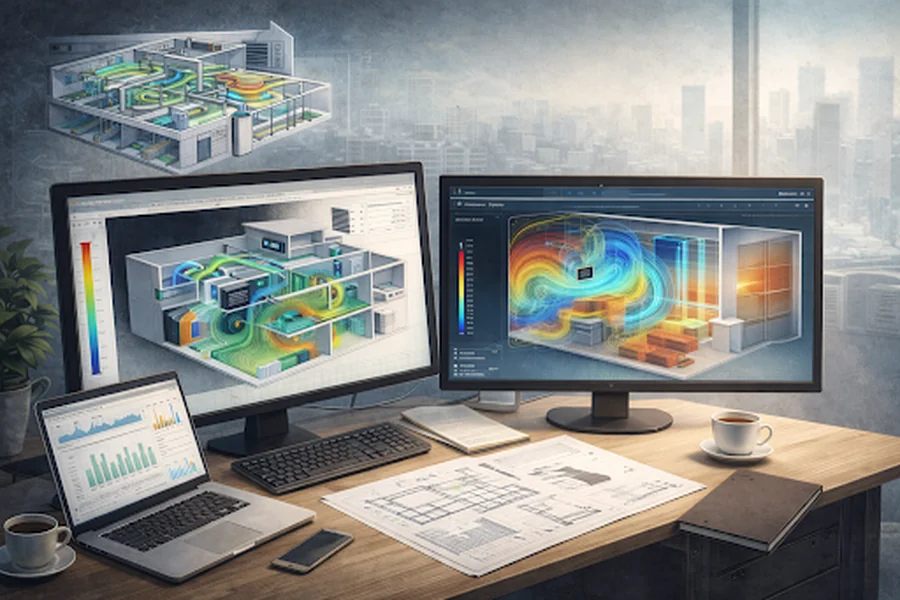
Modern building design increasingly focuses on efficiency, comfort, and sustainability. One critical aspect of this is ventilation, which directly impacts indoor air quality, thermal comfort, and energy consumption. Computational Fluid Dynamics (CFD) ventilation modelling has emerged as an indispensable tool for architects, engineers, and building designers in Singapore and worldwide. By simulating airflow, temperature distribution, and pollutant dispersion, CFD allows professionals to optimise ventilation systems before construction, ensuring safe, comfortable, and energy-efficient spaces.
Understanding what CFD ventilation modelling is, its applications, and its benefits can help building owners and designers make informed decisions in the planning and design stages. By leveraging advanced CFD ventilation modelling, designers can predict real-world airflow behaviour more accurately and tailor solutions to meet both regulatory standards and occupant comfort needs.
What Is CFD Ventilation Modelling?
CFD ventilation modelling uses advanced computer simulations to analyse and predict how air moves through a space. The process involves creating a digital model of a building, including geometry, materials, and HVAC (heating, ventilation, and air conditioning) systems. Sophisticated algorithms then simulate airflow, temperature changes, and contaminant dispersion under various conditions.
This technology provides a visual and quantitative understanding of airflow patterns, helping designers identify areas of poor ventilation, potential hotspots, or zones with insufficient air circulation. By addressing these issues in the design phase, buildings can achieve optimal indoor air quality and energy performance.
Applications in Building Design
CFD ventilation modelling is widely applied in both commercial and residential buildings. In offices, hospitals, and laboratories, it ensures adequate airflow to maintain comfort, minimise disease transmission, and comply with safety standards. In residential developments, CFD helps design efficient natural ventilation systems, reducing reliance on air conditioning and lowering energy costs.
Specialised applications also exist in industrial settings, such as factories or data centres, where precise control of airflow and temperature is critical for safety and equipment performance. CFD simulations allow engineers to test different configurations and optimise ventilation strategies before implementing them on-site.
Benefits of Using CFD Ventilation Modelling
The benefits of CFD ventilation modelling are extensive. First, it enhances indoor air quality by predicting airflow patterns and identifying areas prone to stagnant air or pollutant accumulation. This is especially important in healthcare facilities, high-occupancy spaces, and buildings with strict hygiene requirements.
Second, it improves thermal comfort by ensuring even temperature distribution, reducing hot or cold spots that can affect occupant satisfaction. Energy efficiency is another key advantage. By optimising airflow and ventilation strategies, CFD helps minimise energy consumption, contributing to sustainability goals and lowering operational costs.
Additionally, CFD modelling reduces the risk of design errors. Changes can be made in the digital model without costly physical modifications, saving time, money, and resources during construction.
Integration with Sustainable Building Practices
In Singapore, where sustainability and green building standards are a priority, CFD ventilation modelling aligns with initiatives such as the Building and Construction Authority (BCA) Green Mark Scheme. By simulating airflow and energy performance, designers can incorporate natural ventilation, reduce HVAC loads, and meet stringent environmental standards.
CFD also supports innovative designs, such as atriums, green walls, and open-plan offices, where airflow dynamics are complex. Simulations provide confidence that these design elements will function as intended without compromising indoor comfort or safety.

Choosing CFD Ventilation Modelling Services
When selecting a CFD ventilation modelling service, it is important to consider experience, software capability, and understanding of local regulations. Reputable providers in Singapore can simulate complex scenarios, interpret results accurately, and offer actionable recommendations for optimising ventilation systems.
Collaboration between architects, engineers, and CFD specialists ensures that the final design is practical, efficient, and compliant with safety and sustainability requirements.
Conclusion
CFD ventilation modelling has become an essential component of modern building design. Predicting airflow, temperature distribution, and pollutant behaviour, it enables designers to optimise ventilation systems for comfort, safety, and energy efficiency.
In Singapore’s climate-conscious and densely populated environment, CFD provides the precision and insight needed to create sustainable, healthy, and high-performing buildings. Incorporating CFD ventilation modelling early in the design process ensures better outcomes, reduces costs, and supports long-term building performance.
FAQs
What is the main purpose of CFD ventilation modelling?
It is used to simulate and optimise airflow, temperature distribution, and indoor air quality in buildings before construction.
Can CFD help reduce energy consumption?
Yes. By optimising ventilation systems and reducing reliance on mechanical cooling, CFD can lower energy usage and operational costs.
Is CFD modelling only for large buildings?
No. CFD can be applied to both residential and commercial buildings, as well as specialised industrial facilities.
How do I choose a CFD ventilation service provider?
Look for experience, advanced simulation software, knowledge of local regulations, and the ability to provide actionable design recommendations.
