
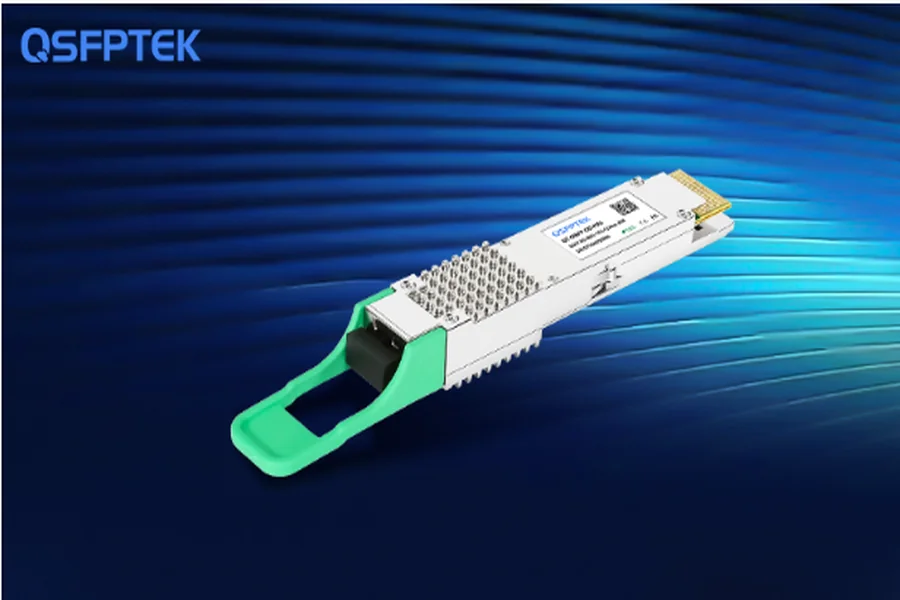
The rise of high-performance computing, AI, and hyperscale cloud services continues to push data center networks toward unprecedented speeds and densities. In this landscape, 400G optical interconnects have transitioned from a future-facing standard to a present-day necessity for backbone infrastructure. Among the various form factors enabling this leap, the QSFP-DD (Quad Small Form-Factor Pluggable Double Density) has emerged as a dominant, hot-pluggable solution. Its compact design doubles the port density of its QSFP28 predecessor while supporting eight high-speed electrical lanes, making it an ideal vehicle for 400G transmission. This article provides a clear overview of the primary 400G QSFP-DD transceiver types and explores practical connection solutions to help you deploy these powerful modules effectively.
Complete List of 400G QSFP-DD Optical Transceiver Types
To meet diverse reach, fiber type, and cost requirements, the industry has standardized several 400G QSFP-DD variants. The naming convention typically indicates the reach (e.g., SR, DR, FR, LR) and the number of optical lanes. The following table provides a detailed comparison of the most common types.
| Type | Max Reach | Wavelength | Fiber Optic | Connector | Modulation | Key Protocol/Standard |
| 400G SR8 | 100m (OM4) / 70m (OM3) | 850nm | Multi-mode Fiber (MMF) | MPO/MTP-16 | 50G PAM4 | IEEE 802.3cm |
| 400G DR4 | 500m | 1310nm | Single-mode Fiber (SMF) | MPO/MTP-12 | 100G PAM4 | IEEE 802.3bs |
| 400G FR4 | 2km | CWDM4 (1271,1291,1311,1331nm) | Single-mode Fiber (SMF) | LC Duplex | 100G PAM4 | 100G Lambda MSA |
| 400G LR4 | 10km | CWDM4 wavelengths | Single-mode Fiber (SMF) | LC Duplex | 100G PAM4 | 100G Lambda MSA |
| 400G LR8 | 10km | 1310nm | Single-mode Fiber (SMF) | LC Duplex | 50G PAM4 | IEEE 802.3bs |
Here’s a breakdown of the naming logic:
SR (Short Reach): Designed for very short connections within a rack or across adjacent racks using multimode fiber (MMF). The “8” denotes 8 parallel fiber lanes.
DR (Datacenter Reach): Uses single-mode fiber (SMF) for distances up to 500 meters, typical for intra-data center or campus links. “4” indicates 4 optical lanes.
FR (Fixed Reach) & LR (Long Reach): Both are for longer single-mode fiber links. FR is suited for data center interconnects (DCI) within a campus, while LR is for metro connections. FR4 and LR4 use wavelength division multiplexing (WDM) to carry 4 channels over one duplex LC fiber pair, maximizing fiber efficiency.
Common Connection Solutions for 400G QSFP-DD Optical Transceivers
Selecting the right module is only half the battle; understanding how to connect it is crucial. Here are standard connectivity scenarios for key transceiver types.
400G QSFP-DD SR8
The 400G SR8 is the workhorse for high-density, short-reach applications. It uses an MPO-16 connector with 16 fibers (8 Tx, 8 Rx).
- 400G to 400G Interconnect: The most straightforward link. Two 400G SR8 modules are connected via a straight-through MPO-16 to MPO-16 fiber trunk, enabling a 400G link up to 100m over OM4 MMF.
- 400G to 2x 200G Breakout: A single 400G port can be split to connect to two 200G SR4 ports. This is achieved using an MPO-16 to 2x MPO-8 breakout cable. This is highly efficient for network aggregation.
- 400G to 8x 50G Breakout: For maximum flexibility, a 400G SR8 port can fan out to eight 50G SFP56 ports. This requires an MPO-16 to 8x LC duplex breakout cable, where each LC pair carries a 50G signal.
400G QSFP-DD DR4 / XDR4/DR4+
The 400G DR4 family uses an MPO-12 connector and is ideal for cost-effective single-mode 500m links.
- 400G to 400G Interconnect: Connect two DR4 modules with an MPO-12 to MPO-12 SMF trunk cable.
- 400G to 4x 100G Breakout: A critical use case for DR4 is connecting a 400G switch to four 100G switches or servers. This is done using an MPO-12 to 4x LC duplex breakout cable. The 400G DR4 port seamlessly breaks out into four independent 100G DR (1310nm) channels.
For XDR4/DR4+: These extended-reach variants (up to 2km) use the same MPO-12 connector but can interoperate with 100G FR receivers on the far end when using the appropriate breakout cable.
400G QSFP-DD FR4
The 400G FR4 is a duplex LC solution, simplifying cabling by carrying four wavelengths over one fiber pair.
- 400G to 400G Interconnect: The connection is simple and clean—two FR4 modules are linked with a standard LC duplex single-mode fiber patch cord, supporting a 2km reach.
- Interoperability Considerations: A key advantage of FR4 is its wavelength compatibility with the established 100G CWDM4 standard. This allows a 400G FR4 port, when paired with appropriate optics on the far end, to connect to 100G CWDM4 networks, protecting previous infrastructure investments.
Conclusion
The transition to 400G networking is a strategic step in building scalable, high-bandwidth data centers. The QSFP-DD form factor, with its diverse portfolio of SR8, DR4, FR4, and LR4 transceivers, provides the flexibility needed for various reach and density requirements. Success hinges not only on choosing the right module but also on implementing the correct connection solution—whether it’s a straightforward point-to-point link or a sophisticated breakout configuration that optimizes port utilization. By understanding these types and their associated connectivity rules, network architects can design efficient, cost-effective, and future-ready 400G infrastructure.
