
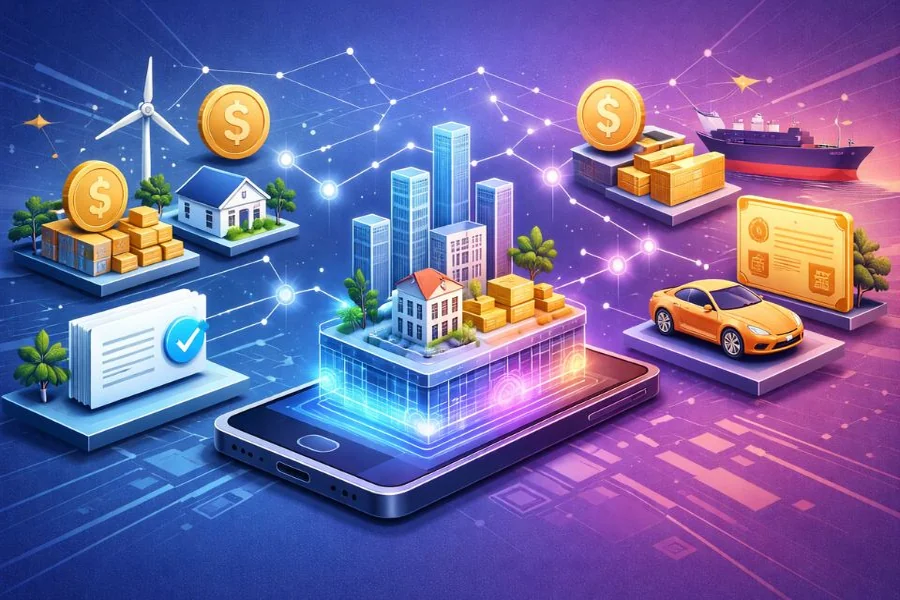
Asset tokenization is rewriting the rules of how the world invests. By converting ownership rights in real estate, insurance products, bonds, private equity, and dozens of other asset classes into digital tokens on a blockchain, tokenization is dismantling the barriers that have historically kept high-value investments locked away from everyday investors. What once required millions of dollars, a network of intermediaries, and weeks of paperwork can now be represented as a fraction of a token, settled in minutes, and traded by an investor anywhere in the world.
Blockchain technology is the engine behind this shift. It gives every tokenized asset a single, tamper-proof source of truth for ownership, provenance, and transaction history — replacing fragmented registries, manual reconciliation, and opaque intermediary chains with programmable, auditable digital securities. The result is a financial system where fractional ownership, instant settlement, and global investor access are the default, not the exception.
This guide is a complete map of that transformation: what asset tokenization is, how it technically works, which asset classes are being tokenized today, and why real estate tokenization and insurance tokenization in particular are emerging as the two fastest-moving frontiers of the tokenized economy. Along the way, we will look at real-world case studies, the regulatory landscape, the risks that still need managing, and where the market is headed next.
About Spydra
Spydra is an enterprise blockchain and asset tokenization platform built on Hyperledger Fabric, designed to help institutions tokenize real-world assets without the complexity of building blockchain infrastructure from scratch. Through modular components — including a Token Engine, configurable Workflows, event-driven Listeners, and data Oracles — Spydra enables banks, real estate developers, insurers, and enterprises to issue, manage, and scale tokenized assets under a fully compliant, permissioned framework.
Spydra’s platform is trusted by institutions including ICICI Bank, IDFC First Bank, Bajaj Finserv, Bosch, and Jio, and supports tokenization use cases across real estate, financial assets, ESG and carbon credits, pharma, jewellery and gemstones, dairy, insurance, and supply chain finance. Backed by ISO 27001, ISO 9001, SOC 2, GDPR, and CMMI Level 3 certifications, and connected to the public RWA marketplace OpenRWA.io, Spydra gives enterprises a compliant, audit-ready path to unlocking liquidity from assets that have traditionally been difficult to trade — reporting up to a 90% reduction in the cost and time required to structure and issue tokenized assets.
1. What Is Asset Tokenization?
Asset tokenization is the process of converting ownership rights in a physical or financial asset into a digital token recorded on a blockchain. Each token represents a verifiable, tradable claim on all or part of the underlying asset — whether that is a share of a commercial building, a slice of a private equity fund, or a fraction of a fine art collection. Because the token lives on a distributed ledger, ownership records are transparent, tamper-resistant, and instantly transferable between investors, without relying on a central registrar.
In practical terms, tokenized assets fall into two broad categories: security tokens, which represent regulated financial instruments such as equity, debt, or real estate and are subject to securities law, and asset-backed tokens, which are collateralized 1:1 by a physical or financial reserve such as gold, a property, or a bond. Both categories rely on the same underlying principle — using blockchain investment infrastructure to make traditionally illiquid, hard-to-access assets programmable, divisible, and tradable as digital securities.
2. How Asset Tokenization Works
While the specifics vary by asset class and jurisdiction, the asset tokenization process generally follows five stages:
- Asset selection and due diligence: The issuer identifies the asset — a property, a bond, an insurance pool, a private equity stake — and undertakes legal, financial, and technical due diligence to confirm it is suitable for tokenization.
- Legal structuring: A special purpose vehicle (SPV) or equivalent legal wrapper is typically created to hold the underlying asset, with the tokens representing beneficial or economic interest in that structure.
- Token design and issuance: Developers define the token standard, supply, transfer restrictions, and compliance logic (KYC/AML, whitelisting), then issue the tokens on a permissioned or public blockchain network.
- Smart contract deployment: Smart contracts encode the rules governing the token — distributions, voting rights, transfer restrictions, and redemption — and execute them automatically without manual intervention.
- Distribution and secondary trading: Tokens are offered to investors through a private placement, public offering, or regulated marketplace, after which they may trade on compliant secondary markets, unlocking liquidity that was previously unavailable.
3. Types of Assets That Can Be Tokenized
Almost any asset with a defined economic value can, in principle, undergo asset tokenization. The most active categories in today’s asset tokenization landscape include:
- Real estate: commercial buildings, residential portfolios, and land parcels tokenized for fractional ownership and cross-border investment.
- Insurance products: policies, reinsurance pools, and parametric coverage represented as tokenized instruments with automated claims logic.
- Stocks: equity in public or private companies issued as security tokens with on-chain cap tables.
- Bonds: government and corporate debt instruments tokenized for faster issuance and settlement.
- Commodities: gold, precious metals, and agricultural commodities backed 1:1 by physical reserves.
- Art and collectibles: fine art, wine, and luxury collectibles fractionalized for broader investor participation.
- Intellectual property: patents, trademarks, and royalty streams tokenized to unlock licensing revenue as an investable asset.
- Private equity: fund interests and direct equity stakes tokenized to lower minimum investment thresholds and improve secondary liquidity.
4. Benefits of Asset Tokenization
| Benefit | What It Means for Investors |
|---|---|
| Fractional ownership | Buy a fraction of a high-value asset instead of the whole thing |
| Increased liquidity | Trade tokenized positions on secondary markets instead of waiting years for an exit |
| Lower investment barriers | Entry points as low as $50–$100 instead of six- or seven-figure minimums |
| Global investor access | Participate from anywhere, subject to local regulatory eligibility |
| Faster settlement | T+0 or near-instant settlement instead of T+2 to T+5 |
| Transparency | Immutable, auditable on-chain ownership and transaction history |
| Reduced costs | Fewer intermediaries and automated compliance lower issuance and transfer costs |
Collectively, these benefits are why asset tokenization is increasingly described as a form of digital investment innovation rather than a niche crypto experiment. Asset tokenization combines the regulatory protections of traditional digital securities with the efficiency of decentralized finance (DeFi) infrastructure — a hybrid that institutional investors are increasingly comfortable underwriting.
5. Why Asset Tokenization Is Revolutionizing Global Investment
Institutional forecasts diverge sharply on the ultimate size of the tokenized asset market, but they agree on direction. Boston Consulting Group’s initial 2022 analysis with ADDX projected tokenized assets could reach
Boston Consulting Group’s initial 2022 analysis with ADDX projected tokenized assets could reach $16 trillion by 2030, roughly 10% of global GDP; its 2025 update with Ripple revised this to a still-substantial $9.4 trillion by 2030 and $18.9 trillion by 2033. McKinsey & Company takes a more conservative bottom-up view, estimating tokenized financial assets — excluding stablecoins and CBDCs — will reach roughly $1.9 trillion to $4 trillion by 2030, led by bonds, mutual funds, and securitized loans. Citigroup’s GPS report sits in between, forecasting $4–5 trillion in tokenized digital securities.
What matters more than any single number is the underlying pattern: every major forecast — whether conservative or bullish — sees tokenization moving from pilot projects to mainstream financial infrastructure this decade. Asset tokenization is revolutionizing global investment because it collapses three historical constraints simultaneously: capital minimums that excluded retail investors, geographic barriers that limited cross-border participation, and settlement friction that tied up capital for days. Institutions from BlackRock to JPMorgan are already routing money-market funds and broker-dealer flows through tokenized infrastructure, signaling that this is no longer speculative — it is a live, scaling shift in how capital moves.
6. Real Estate Tokenization
Real estate tokenization is the process of converting ownership rights in a property — residential, commercial, or industrial — into digital tokens on a blockchain, allowing investors to buy, hold, and trade fractional interests instead of purchasing an entire property outright. It is widely considered the leading edge of the broader tokenized real-world asset (RWA) market.
What Real Estate Tokenization Is
Rather than requiring a buyer to purchase 100% of a property, real estate tokenization divides ownership into thousands of digital tokens, each representing a proportional economic interest — including rental income and any capital appreciation. Ownership transfers happen on-chain, replacing lengthy title transfers and escrow processes with near-instant settlement.
Benefits and Fractional Property Ownership
Real estate tokenization directly addresses the two problems that have long constrained property investing: high capital minimums and poor liquidity. Fractional property ownership allows an investor to hold a $500 stake in a commercial tower instead of needing millions of dollars in capital, while tokenized real estate can, in principle, be resold on a secondary market rather than sitting through a multi-month traditional sale process.
Commercial Real Estate and Residential Investments
Commercial real estate tokenization — office buildings, logistics hubs, and retail centers — currently leads the market because these assets generate predictable income streams and involve fewer regulatory complications than residential mortgages. Residential real estate tokenization is growing but faces additional friction: many jurisdictions treat residential title transfer and mortgage regulation differently, which slows adoption relative to commercial assets.
Cross-Border Investing
Because tokenized real estate settles on a shared digital ledger, an investor in Singapore can hold a fractional stake in a New York office building or a London retail unit without the friction of cross-border wire transfers, foreign notarization, or multiple layers of custodial intermediaries — subject, of course, to each investor meeting the eligibility and KYC requirements of the issuing jurisdiction.
Market Growth
Estimates of the real estate tokenization market vary by methodology, but the direction is consistent. Roland Berger valued tokenized real estate at roughly $120 billion in 2023, projecting growth to approximately $3 trillion by 2030 at roughly a 49–60% compound annual growth rate, a trajectory BCG’s independent modeling arrives at as well. Separately, market-research firms tracking real estate tokenization platform revenue and transaction volume put the narrower services market at roughly $3.5–3.8 billion in 2025, growing at a 21–24% CAGR through the early 2030s. Institutional surveys from EY found that a majority of high-net-worth and institutional investors were already investing or planning to invest in tokenized assets, with real estate ranking as the second most attractive asset class among both groups.
Real-World Examples
Elevated Returns’ tokenization of the equity in the St. Regis Aspen Resort — raising roughly $18 million from investors — is one of the earliest and most cited examples of commercial real estate tokenization in practice. More recently, institutional infrastructure providers, including custody networks tied to major global banks, have begun piloting cross-network transfer standards specifically to support secondary trading of tokenized property interests, a signal that real estate tokenization is moving from boutique platforms toward mainstream capital markets plumbing.
7. Insurance Tokenization
Insurance tokenization applies the same fractional-ownership and programmable-settlement logic that is reshaping real estate to the insurance value chain — representing policies, risk pools, and reinsurance capacity as digital tokens governed by smart contracts.
What Insurance Tokenization Is
At its core, insurance tokenization converts an insurance policy, a pool of premiums, or a reinsurance treaty into a digital token that records ownership, premium flows, and claims obligations on a blockchain. This creates a single, shared source of truth between insurers, reinsurers, and policyholders — reducing the reconciliation overhead that traditionally comes from each party maintaining its own separate records.
Tokenized Insurance Products and Parametric Insurance
The clearest early use case for tokenized insurance is parametric insurance, where payouts are triggered automatically once a predefined, independently verifiable condition is met — a rainfall threshold, a flight delay, or a wind-speed reading — rather than requiring a manual claims assessment. Oracles feed real-world data (weather stations, IoT sensors, flight-tracking APIs) onto the blockchain, and a smart contract compares that data against the policy’s trigger conditions to release payment automatically.
Smart Contracts and Claims Automation
Smart contracts are the mechanism that makes tokenized insurance practical at scale. Instead of a claims adjuster investigating a loss and negotiating a settlement — a process that can take weeks — a smart contract can verify an oracle-fed data point and release funds within minutes. Industry estimates suggest blockchain-based systems can cut duplicate insurance claims dramatically and shrink claims settlement times from weeks to hours in well-instrumented lines of business. The broader smart-contract-for-parametric-insurance market has been estimated at roughly $9.5 billion in 2024, growing to $25.6 billion by 2034 — a compound annual growth rate of just over 10%.
Risk Sharing and Reinsurance Opportunities
Tokenization also opens new structures for risk sharing. Rather than a single insurer absorbing an entire risk, tokenized risk pools let multiple capital providers — from institutional reinsurers to individual investors — hold a proportional token representing their share of premium income and claims exposure. This mirrors how catastrophe bonds already work in traditional reinsurance markets, but with on-chain transparency into pool composition and real-time claims status, and with fractional entry points that were previously reserved for large institutional reinsurance capital.
Benefits for Insurers and Policyholders
- Faster claims: automated verification and payout replace manual adjustment for eligible parametric triggers.
- Lower fraud exposure: a shared, immutable ledger reduces duplicate and fraudulent claims across insurer networks.
- New capital access: tokenized risk pools let insurers bring in a broader base of reinsurance capital, including smaller institutional and accredited investors.
- Product innovation: microinsurance and highly specific coverage (a single flight, a single harvest cycle) become economically viable when issuance and settlement are automated.
8. Asset Tokenization Across Industries
Beyond real estate and insurance, asset tokenization is reshaping capital formation across supply chain finance (tokenizing invoices and inventory for working-capital access), ESG and carbon credits (tokenized credits with verifiable retirement records), pharma and jewellery supply chains (provenance and authenticity tracking tied to a tokenized digital twin), and private equity and venture capital (fund interests tokenized to create secondary liquidity for otherwise locked-up capital). In each case, the underlying pattern of asset tokenization is the same: a traditionally illiquid or opaque asset class gains fractional ownership, transparent provenance, and programmable compliance.
9. Challenges and Risks
- Regulatory uncertainty: asset tokenization security token classification and cross-border rules still differ significantly by jurisdiction.
- Liquidity gaps: secondary markets for tokenized assets remain thinner than public equity or bond markets today.
- Valuation complexity: illiquid assets like real estate and private equity are harder to price consistently on-chain.
- Smart contract risk: bugs or exploits in contract code can affect fund security if asset tokenization contracts are not independently audited.
- Interoperability: tokens issued on different blockchain networks do not always trade seamlessly across platforms.
- Investor education: many retail and institutional investors are still unfamiliar with how asset tokenization and tokenized securities differ from cryptocurrencies.
10. Regulatory Landscape
Regulatory treatment of asset tokenization varies considerably by region. The European Union’s Markets in Crypto-Assets Regulation (MiCA) became fully applicable across the bloc in late 2024, giving issuers a harmonized framework for token issuance and disclosure. In the United States, tokenized securities generally fall under existing securities law — including Regulation D and Regulation A+ exemptions — but there is no single unified federal statute governing asset tokenization, and enforcement activity against non-compliant offerings has been significant. Singapore’s Monetary Authority and Hong Kong’s Securities and Futures Commission have both taken proactive positions, running live pilots (including Project Guardian) that explicitly test tokenized real estate, bonds, and funds under regulatory supervision. For any enterprise pursuing asset tokenization, working with a platform built around KYC, AML, and jurisdiction-specific compliance from day one — rather than retrofitting compliance later — remains the difference between a scalable offering and a stalled one.
11. Security Considerations
Because asset tokenization combines legal ownership structures with executable code, security spans two layers: the smart contract layer and the custody layer. Independent smart contract audits, multi-signature controls for high-value transfers, and time-locked contract upgrades all reduce the risk of exploits. On the custody side, enterprise asset tokenization platforms typically rely on permissioned blockchain networks — rather than fully public chains — for sensitive asset classes, pairing on-chain verification with off-chain storage of personally identifiable or commercially sensitive data to balance transparency with privacy.
12. Technologies Powering Asset Tokenization
- Permissioned blockchain frameworks: networks such as Hyperledger Fabric give enterprises channel-based privacy and pluggable consensus suited to regulated asset classes.
- Smart contracts: self-executing code that enforces distributions, transfer restrictions, and compliance logic automatically.
- Oracles: bridges that feed verified real-world data — property valuations, weather readings, market prices — onto the blockchain to trigger contract logic.
- Token standards: frameworks like ERC-3643 embed whitelisting, identity verification, and transfer restrictions directly into the token, enabling compliant secondary trading.
- Digital asset management platforms: dashboards and APIs — such as Spydra’s Token Engine, Workflows, and Listeners — that let enterprises issue and manage asset tokenization projects without building blockchain infrastructure in-house.
13. Real-World Case Studies
The following asset tokenization case studies illustrate how tokenized real estate, fixed income, funds, and insurance are already operating at meaningful scale rather than remaining purely theoretical.
| Case Study | Asset Class | Outcome |
|---|---|---|
| St. Regis Aspen Resort (Elevated Returns) | Commercial real estate | Raised roughly $18 million via tokenized equity, an early proof point for real estate tokenization |
| Hong Kong digital government bonds | Fixed income | Multiple tokenized bond issuances including a HK$10 billion (~$1.28 billion) offering, with tokenized issuance planned as a recurring market feature |
| BlackRock BUIDL fund | Money market fund | Grew into one of the largest tokenized funds on a public blockchain, signaling institutional confidence in tokenized cash-equivalent products |
| Lemonade parametric drought insurance (Kenya) | Parametric insurance | Automated payouts to thousands of farmers without manual claims submission, using weather-triggered smart contracts |
14. Future Trends
- Institutional infrastructure convergence: major banks are building proprietary asset tokenization platforms rather than treating tokenization as an experimental side project.
- Cross-chain interoperability standards: emerging frameworks aim to let tokenized assets move across multiple blockchain networks without re-authentication or fragmented liquidity.
- Expansion beyond financial instruments: intellectual property, carbon credits, and supply chain assets are expected to see accelerating asset tokenization activity alongside real estate and fixed income.
- Deeper DeFi integration: tokenized real-world assets are increasingly used as collateral within decentralized finance protocols, blurring the line between traditional and decentralized finance.
- Regulatory convergence: as frameworks like MiCA mature and more jurisdictions run live pilots, cross-border asset tokenization offerings should become easier to structure compliantly.
15. Frequently Asked Questions
Q: What is asset tokenization in simple terms?
A: Asset tokenization is the process of converting ownership rights in a real or financial asset — such as property, a bond, or an insurance policy — into a digital token on a blockchain, allowing that ownership to be divided, transferred, and traded more easily than through traditional paperwork-based systems.
Q: How does real estate tokenization work?
A: A property (or the entity that holds it) is divided into digital tokens, each representing a proportional economic interest, including rental income and appreciation. Investors buy tokens instead of the whole property, and ownership transfers are recorded on a blockchain rather than through a traditional title transfer process.
Q: Is insurance tokenization the same as buying crypto insurance?
A: No. Insurance tokenization represents traditional insurance policies, premium pools, or reinsurance capacity as digital tokens with smart-contract-based administration. It is distinct from products that insure cryptocurrency holdings, though both sit within the broader blockchain investment ecosystem.
Q: What is parametric insurance and how does tokenization improve it?
A: Parametric insurance pays out automatically when a predefined, verifiable condition is met — such as a rainfall threshold — rather than requiring a manual damage assessment. Tokenization and smart contracts make this automation auditable, faster, and less prone to disputes over what was actually triggered.
Q: Are tokenized assets considered digital securities?
A: Many are. Tokens representing regulated financial instruments such as equity, debt, or real estate typically qualify as security tokens and are subject to the same securities regulations as their traditional counterparts, even though they are issued and transferred on a blockchain.
Q: How much money do I need to start investing in tokenized real estate?
A: Minimum investment thresholds vary by platform and jurisdiction, but tokenization has pushed entry points down to as little as $50–$100 on some platforms, compared to the six- or seven-figure minimums traditionally required for direct commercial property investment.
Q: What are the biggest risks of asset tokenization?
A: The main risks include regulatory uncertainty across jurisdictions, thinner secondary-market liquidity than investors may expect, smart contract vulnerabilities if code is not independently audited, and valuation complexity for illiquid underlying assets.
Q: Is asset tokenization regulated?
A: Yes, in most major markets. The EU’s MiCA framework, US securities law (including Regulation D and Regulation A+ exemptions), and regulatory sandboxes in Singapore and Hong Kong all apply existing or purpose-built rules to asset tokenization offerings, though the specifics vary by jurisdiction and asset type.
Q: How big is the asset tokenization market expected to become?
A: Estimates vary widely by methodology and scope. McKinsey’s base case projects $1.9–4 trillion in tokenized financial assets by 2030, while BCG’s broader asset tokenization model — including illiquid assets like real estate and private equity — projects a range as high as $9.4–16 trillion over the same period.
Q: What role does blockchain infrastructure like Hyperledger Fabric play?
A: Permissioned blockchain frameworks such as Hyperledger Fabric give enterprises the channel-based privacy, pluggable consensus, and compliance controls needed to tokenize regulated assets like real estate and insurance products at institutional scale, without exposing sensitive data on a fully public network.
16. Conclusion
Asset tokenization is no longer a speculative thought experiment — it is an active, scaling shift in how capital is raised, held, and traded. Real estate tokenization and insurance tokenization are two of the clearest proof points: both take asset classes long defined by high entry costs, slow settlement, and manual processes, and rebuild them around fractional ownership, transparency, and automated execution. Whether the tokenized asset market lands closer to McKinsey’s conservative multi-trillion-dollar estimate or BCG’s more expansive scenario, the direction is unmistakable — tokenization is becoming core financial infrastructure, not a niche experiment.
For enterprises evaluating how to approach asset tokenization for real estate portfolios, insurance products, or other real-world assets, the technology decision matters as much as the strategy. Spydra’s enterprise asset tokenization platform — built on Hyperledger Fabric and used by institutions including ICICI Bank, IDFC First Bank, Bajaj Finserv, Bosch, and Jio — gives organizations a compliant, audit-ready path to issuing and managing tokenized assets without building blockchain infrastructure from the ground up.
Ready to explore what asset tokenization could unlock for your organization? Visit console.spydra.app to start your tokenization journey with Spydra.
